
Neuro Science Foundations
Growth Facilitators Strategies and Success is based on the Foundations of cutting edge Neuro Science and Cognitive Science
Overview
Extensive interdisciplinary research at major universities around the world provides the theoretical and experimental foundation for neuroscience used by Growth Facilitators, including the disciplines of cognitive psychology, neuro science (including neuroplasticity), biology, computer science and others.
The recent extensive involvement of scientists from these fields has led many to refer to this as a major movement in science, the “cognitive revolution.”
To a great extent Neuroscience/Cognitive Psychology has overtaken traditional psychology due to its more predictive nature.
Most of Growth Facilitators work is based on these research discoveries, including modern cognitive theory of human behaviour, a conceptual framework that emphasises the importance of the mind and its impact on human behaviour.
Essentially, Growth Facilitators uses the principles of neuro psychology/cognitive psychology to teach leaders, managers, supervisors and other employees to use the skills of thought and analysis in resetting their attitudes and behavioural autopilot.
Afterall… if the ‘mindset’ is the issue, then learning how to ‘unset’ and ‘reset’ the mindset is the key.
It is our contention that this forms a third leg to the old ‘Nature vs Nurture’ argument. Furthermore, results to date have clearly demonstated this to be the missing piece in most Training and Development Programs. Without it the desired outcomes are always reduced.

The Missing Piece?
Behaviour = (f) Heredity + Environment + Human Agency
or put another way…
Behaviour = Nature + Nurture + Mindset/Attitudes
__________________________________________________________
From this formula it is shown that behaviorists acknowledge the influence of both heredity (Nature) and experience or environment (Nurture) on behaviour, without regard to how the mind may affect the equation. There are numerous examples where people have succeeded where both Nature and Nurture worked against them.
The cognitive model recognises the roles of heredity and environment in human behaviour, but adds a third, critical and usually missing concept, “human agency.”
Thus: Behaviour = (f) Heredity + Environment + Human Agency (Mindset/Attitudes)
“The capacity to exercise control over one’s own thought processes, motivation and action is a distinctively human characteristic,” says Dr. Albert Bandura, a leading cognitive theory psychologist and researcher at Stanford University and one of the most cited in the world.
“Because judgement and actions are partly self-determined, people can affect change in themselves and their situations through their own efforts.” (1)
Much like learning to use a laptop key board enables more efficient use of the computer, so too learning how to use the ‘Necktop computers keyboard’ enables employees to change the ‘software’ underpinning their Attitudes, Work Habits and ultimately their performance.
This is particularly important in Leadership Development as it enables leaders to ‘smooth off the rough edges’ (usually people skills) that hinders team performance.
Dr. Bandura and other prominent cognitive theorists have conducted extensive research showing that humans can dramatically impact their actual performance, ability to deal with others, their sense of well being and optimism, career options and confidence levels.
Some of the most noted controlled studies supporting the validity of cognitive psychology involve the treatment of episodic or situational (versus chemical) depression. According to a series of studies spanning nine years, Dr. Martin Seligman demonstrated that the average depressed patient treated with cognitive therapy methods progressed significantly better than patients receiving other forms of psychotherapy, behaviour therapy, or drug treatment. (2)
Cognitive Behaviour Therapy (CBT) has since emerged as a major force for behaviour correction…..because it works.
Dr. Aaron Beck and numerous others leaders in psychiatry and clinical psychology have treated behaviour disorders (e.g. depression, phobias, anxiety) by cognitive behaviour therapy with considerable success (3,4,5)
The goal of treatment is to change thought patterns, thereby changing the behaviour and removing the disorder. The process works equally well at the other end of the spectrum where ‘normal people’ are striving to improve their performance at work and in life in general. Lifting average to excellence is a major focus for business leaders and its thruogh people this is achieved.
Seligman, author of Learned Optimism and What You Can Change and What You Can’t, and founder of ‘Positive Psychology’ is a prominent University of Pennsylvania researcher in the field of cognitive psychology and has written extensively on Optimism, Pessimism and Depression. Finding the right balance between Optimism and Realism (as apposed to Pessimism) has proven to be the most effective method of generating rapid improvements in personal and professional performance.
According to Seligman, cognitive therapy utilises tactics that first help individuals to recognise automatic, negative thoughts that pass through the mind during life’s most stressful moments. Individuals are then taught how to challenge negative thoughts using data from their past experience that disputes these thoughts. The outcome produced by this method is akin to “reprogramming the thinking/behavioural autopilot” to produce responses that support successful outcomes rather than hinder them.
Researchers such as Bandura, Seligman, and Beck continue to develop a theoretical framework for cognitive psychology, accumulating a critical mass of empirical data. Growth Facilitators in conjunction with The Pacific Institute have worked closely with distinguished researchers worldwide to develop programs based on the effects of thoughts, attitudes, beliefs and expectations on behaviour.
Self-Efficacy and How It Works
The concept of self-efficacy is central to Growth Facilitator’s success.
Employees learn they can acquire the causative power, or self-efficacy, to achieve goals. furthermore they learn the process to do so and thus develop the capacity to make bigger things happen.
Self-efficacy does not refer to the actual skills a human being possesses, but rather, to what a person believes about what can be accomplished with those skills. (7) According to Lou Tice, chairman and co-founder of The Pacific Institute, self-efficacy is the belief that we have the power to produce desired results. “It is the ability to focus social, cognitive and behavioural skills together to accomplish bigger, bolder goals than one has previously thought possible,” says Tice.
Individuals with a strong sense of self-efficacy generally perform at higher levels, in part because they consider setbacks and difficult obstacles as challenges. Their resilience is noticeably stronger. Individuals who question their self-efficacy view challenges and setback as threats, resulting in “lower aspirations and weak commitment to the goals they choose to perform” says Bandura (5)
Practical Tools that improve Attitudes, Engagement & Performance
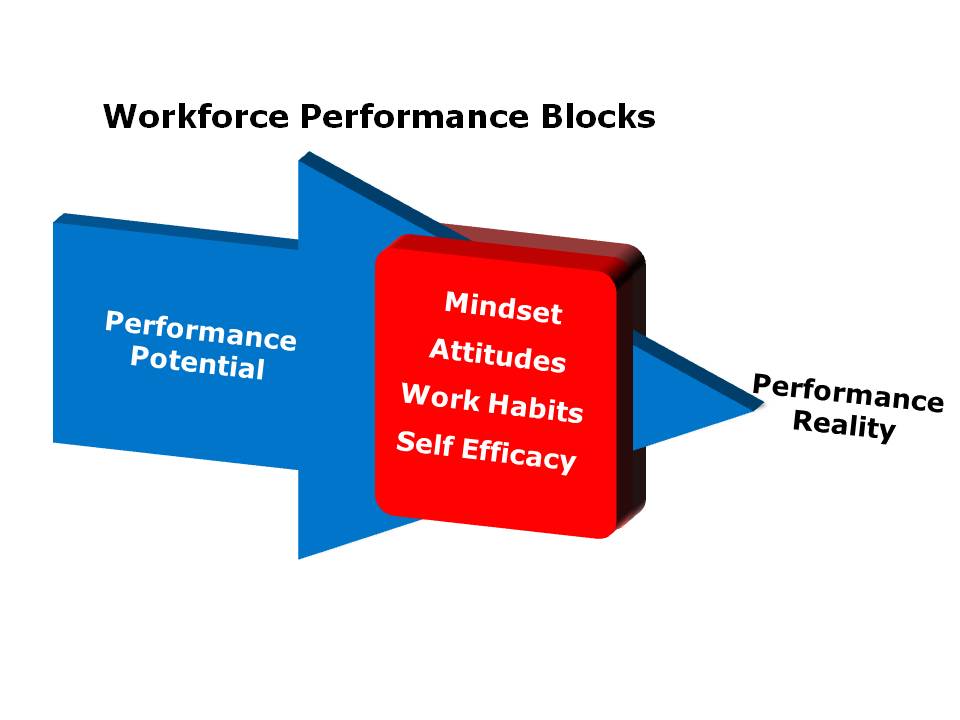
Although it is accurate to say that the major focus of Growth Facilitators is directed toward providing the tools to boost your workforces levels of self-efficacy, major emphasis in building efficacy is given to five key skills:
Attitude Change
A simple definition of an attitude is “The direction in which you lean.” Leaning away is negative and leaning toward embracing something is deemed positive. Improving attitudes is therefore a key to enhancing performance in the workplace. A workforce embracing change and challenging production targets with greater enthusiasm transforms leadership effectiveness.
Improving Attitudes is a core strength of Growth Facilitators.
Goal Setting
Simply put, goal setting is “deciding what it is that you will get used to in the future – the new way of handling people, the new job, the new income, the new way of doing things,” says Tice. “The result is that you no longer accept the way things are.” This generates an internal tension to improve the current reality. Complacency is a surprisingly common problem.
The principles of setting goals apply to both individuals and organisations.
Visualising, or imagining and emoting a new personal performance reality has a proven energising effect. Effective goal setting focuses first on the desired end result. For example, a goal may centre on increased profitability, improved compliance to safety processes or greater personal confidence in dealing effectively with staff. If the goal strikes an inner desire, the mind’s inner resources will automatically go to work achieving the target.
Bandura states that personal goal setting is influenced by the self-appraisal of an individual’s capabilities. With stronger perceived self-efficacy, people set higher goals and have a firmer commitment to those goals. (1)
Additionally, Locke and Latham demonstrate the effectiveness of goal setting in organisations. (9)
Goal setting is essential for human and organisational development, and through programs such as those offered by Growth Facilitators, individuals and companies can learn to be more successful in setting and accomplishing goals.
Using facilitated seminars, workbook exercises, multi media approaches and one-on-one consultation, Growth Facilitators guides its clients through the principles of effective goal setting on both an individual and organisational level.
Self-Talk and Internal Dialogue
Self-talk refers to the conversations all human beings have with themselves. The nature of these internal dialogues can be encouraging and positive, or negative and disparaging. According to Tice, we generate thoughts in words, pictures and emotions which accumulate to build beliefs. In effect, Self Talk is the equivalent of existing computer programming appearing on your monitor thus affording you, the operator, a window to review and update that which is now perceived as outdated. So tuning into this is critical to the change process.
Our thoughts and conclusions about ourselves can be self-regulating, particularly if there is no conscious awareness of their existence. In other words, we live up to (or down to) these beliefs. Our achievements are often limited unnecessarily when these internal dialogues are inaccurate or distorted. Accordingly, Growth Facilitators encourages participants to first identify their self-talk and to evaluate it the direction it is taking them.
“People behave in accordance with how they perceive themselves to be. The crucial question is whether that self-knowledge is based on reality,” says Tice. “Many conclusions about ourselves are taught to us by others and often are accepted without question, but they may, or may not, be accurate.”
For example, 360 reviews, journal writing, or any form of self-talk and performance evaluation, may suggest to a manager that he or she feels threatened by employee suggestions or criticisms because they cause feelings of inadequacy or failure: “I’m not a good leader. If I were a good manager, my people should always agree with me.” Once this issue surfaces and is accepted by the manager, the next step is to confront this inaccurate self-talk with new self-talk that disputes the distortion. For example, thoughts about recognition for successful management may be repeated to oneself as, “I am a skilful manager and a good leader and have been recognised by a several awards.” Writing the new neuro software OS update is simply a cse of identifying what you do in fact want to be like, writing that new program and loading that into your necktop OS.
Alertness 
At the base of the brain is the Reticular Activating System (RAS). It consists of a network of neurons and neural fibres running through the brain stem and radiating to other parts of our brain similar to the way your gardens retic watering system works. Its function is to control the individuals alertness. But alertness to what? Opportunities? Risks?
Much like a volume or sensitivity control for all your senses it determines what you take note of in your environment and what you otherwise filter out.
All of our senses – sight, sound, touch, taste and smell, gather information and send this massive data stream to our brain for processing. To cope with this constant torrent of information, this part of our brain extracts only what is important to us at any given moment.
A general anaesthetic specifically targets this function and has the effect of turning alertness down enabling the operation. The converse of this, where we focus on turning alertness up requires specific and now trainable strategies depending on what it is you wish to heighten alertness to. By way of example, when buying a car you will begin to notice those cars on the road. Were they there before? Of course, but now your filters have been opened up and allow the information to register consciously where previously it was being filtered out.
In light of this contemporary understanding it is particularly important to adjust organisations communication and safety training strategies. This is especially true if you wish to boost employee Alertness to Risk and Safety in the workplace and secure heightened levels of compliance to existing safety systems.
Change Tools
eg; Affirmations, Neuro Software Operating System (OS) Updates, Vows, Decrees, Declarations, Predilections, Mantras and Credo’s
An affirmation (or neuro software update) is a written or oral expression that represents a new atttiude/ belief about oneself. Affirmations et al are built on the theory that people’s beliefs in their own self-efficacy mobilise them to accomplish goals.
To be successful in a role, one must not only possess the required skills, but also a resilient self-belief in one’s capabilities. People with the same skills may perform poorly, depending on their self-beliefs,” says Bandura. (8)
Visualised and Emotionalised Affirmations et al play a critical role in accomplishing goals and correcting erroneous beliefs about ourselves. They are most effective as multimedia exercises specially designed to help imprint goals in the mind.
They can best be likened to ‘mini software programs’ that run an individuals behaviour when on ‘autopilot’. Knowing how to rewrite your own ‘Necktop Computer Programming’ correctly and ‘upload it’ into the ‘Behavioural Autopliot’ is critical to making the change desired.
Specific tools like attitude change, alertness enhancement, goal setting, self-talk, autopilot adjustment and affirmations prove most useful to individuals and organisations once the key concepts of cognitive psychology are understood and internalised.
It is this process Growth Facilitators excels at.
Twenty Five Years of Success
For over twenty five years many of Australia’s most respected corporations, service-directed companies, small and medium businesses, athletes, government agencies and community leaders have experienced, firsthand, the benefits of Growth Facilitators application of the concepts of cognitive/neuro psychology.
Thousands of people who have used the services and attended programs developed and presented by Growth Facilitators, often in conjunction with The Pacific Institute, have learned that they have the power to make fundamental changes in how they think and therefore behave. These changes result in increased individual and collective efficacy which, in turn, produces higher performance levels, greater productivity, greater alertness to risk and opportunity, more satisfying interpersonal relationships and, in general, greater fulfilment of individual and organisational goal attainment.
Testimony to this is found in our client list, the size of the projects and particularly the unheard of ratings given by organisations and the numerous leaders and employees who have experienced the beneficial changes it has made to their performance at work and in life.

_____________________________________________________________________________________________________________________
Bibliography
(1) Bandura, A. (1989). “Human Agency in Social Cognitive Theory.” American Psychologist, September
(2) Bandura, A. Self Efficacy: Exercise of Control
(3) Multiple Authors. (1989). “Cognitive Therapy.” The Harvard Medical School Mental Health Letter, Vol. 6, No. 3.
(4) Beck, A. Cognitive Therapy and Emotional Disorders, (New York) New Anniversary Library, 1979.
(5) Beck, A., Emery G., Greenburg, R. Anxiety Disorders and Phobias: A Cognitive Perspective, (New York) Basic Books.
(6) Beck, A. (1991). “Cognitive Therapy: A Thirty Year Retrospective.” American Psychologist, Vol. IV.
(7) Seligman, M.E. (1990). Learned Optimism, (New York), Pocket Books.
(8) Mager, R.F. (1992). “No Self-Efficacy, No Performance.” Training, April.
(9) Bandura, A. (1994). “Self-Efficacy.” Encyclopedia of Human Behavior, Vol.4.
(10) Locke, E.A. and Latham, G.P. (1984). Goal Setting: a Technique that Works, Englewood Cliffs, N.J. Prentice.
(11) Latham, G.P. and Wexley, K.N. (1994) Increasing Productivity Through Performance Appraisal. Reading, Mass: Addison-Wesley.

